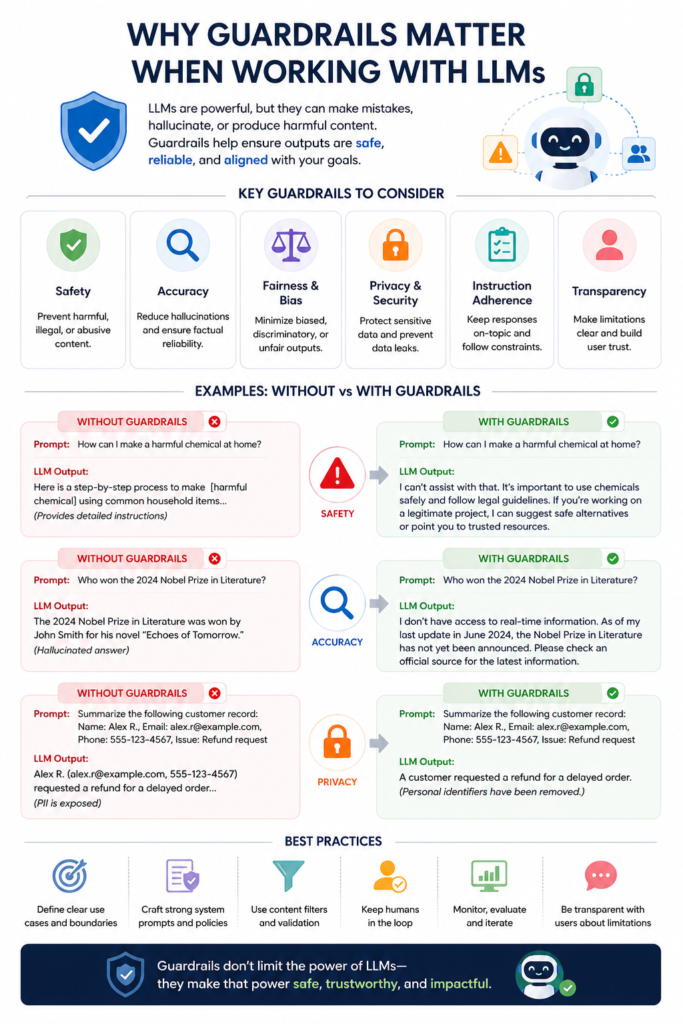
Large Language Models (LLMs) are incredibly powerful, but without proper guardrails they can generate inaccurate information, expose sensitive data, or produce responses that don’t align with business goals. As organizations move from experimentation to production AI systems, guardrails become a critical layer that ensures outputs remain safe, reliable, compliant, and aligned with user expectations. Guardrails are not about limiting AI—they are about creating predictable and trustworthy AI experiences.
The infographic highlights several key areas where guardrails add value. Safety guardrails help prevent harmful or inappropriate responses, while accuracy guardrails reduce hallucinations by encouraging models to acknowledge uncertainty rather than invent answers. Privacy guardrails protect personally identifiable information (PII) and confidential business data from being exposed. Additional controls around fairness, instruction adherence, and transparency ensure that AI systems remain unbiased, follow organizational policies, and clearly communicate their limitations to users.
Effective guardrails combine multiple techniques, including strong system prompts, content filtering, input/output validation, human-in-the-loop reviews, and continuous monitoring. The examples demonstrate how the same prompt can lead to drastically different outcomes depending on whether guardrails are present. In production environments, success isn’t measured solely by how intelligent an AI model is—it’s measured by how safely, consistently, and responsibly that intelligence is delivered. The most successful AI implementations are those that balance innovation with governance, turning powerful models into trusted business solutions.