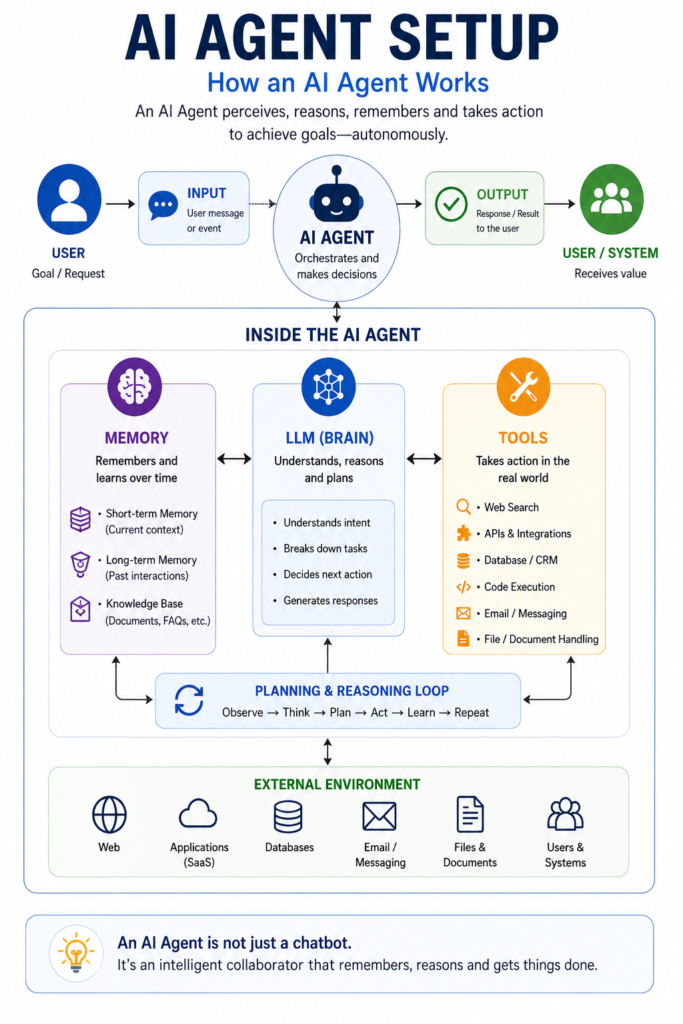
Most people think AI is just a chatbot answering questions. But modern AI Agents go much further—they can reason, remember, plan, and take action across multiple systems to achieve business goals autonomously.
What Makes an AI Agent Different?
An AI Agent combines three core capabilities:
🧠 Memory
Memory allows the agent to retain context and learn over time.
- Short-term memory remembers the current conversation and task.
- Long-term memory stores past interactions and preferences.
- Knowledge bases provide access to company documents, policies, and FAQs.
This enables personalized and context-aware interactions.
🤖 LLM (The Brain)
The Large Language Model acts as the agent’s reasoning engine.
It can:
- Understand user intent
- Analyze complex requests
- Break large tasks into smaller steps
- Make decisions on what to do next
- Generate responses and recommendations
The LLM is responsible for planning and reasoning.
🛠️ Tools
Tools allow the AI Agent to interact with the real world.
Examples include:
- Web search
- APIs and SaaS applications
- Databases and CRMs
- Email and messaging systems
- File and document processing
Without tools, AI can only provide information. With tools, it can perform actions.
How an AI Agent Works
The typical workflow follows a continuous loop:
Observe → Think → Plan → Act → Learn → Repeat
- User provides a goal or request.
- The agent retrieves relevant memory.
- The LLM reasons and creates a plan.
- Tools execute required actions.
- Results are returned to the user.
- New information is stored for future interactions.
This creates an intelligent feedback loop that improves effectiveness over time.
Why Businesses Are Investing in AI Agents
AI Agents offer significant advantages:
✅ Automate repetitive workflows
✅ Operate across multiple systems
✅ Deliver personalized experiences
✅ Reduce manual effort
✅ Improve decision-making speed
✅ Scale operations without proportional headcount growth
The Future of Work
AI Agents are not replacing humans—they are becoming intelligent collaborators.
Think of them as digital team members that can remember context, reason through problems, access tools, and execute tasks on demand.
The organizations that successfully combine Memory + LLMs + Tools + Business Data will unlock a new level of productivity and operational efficiency.
AI Agents are not just answering questions anymore—they are getting work done.