As Generative AI becomes part of everyday business workflows, one challenge continues to attract attention: hallucination. An AI model may confidently provide an answer that sounds accurate, yet contains fabricated facts, incorrect references, or misleading conclusions.
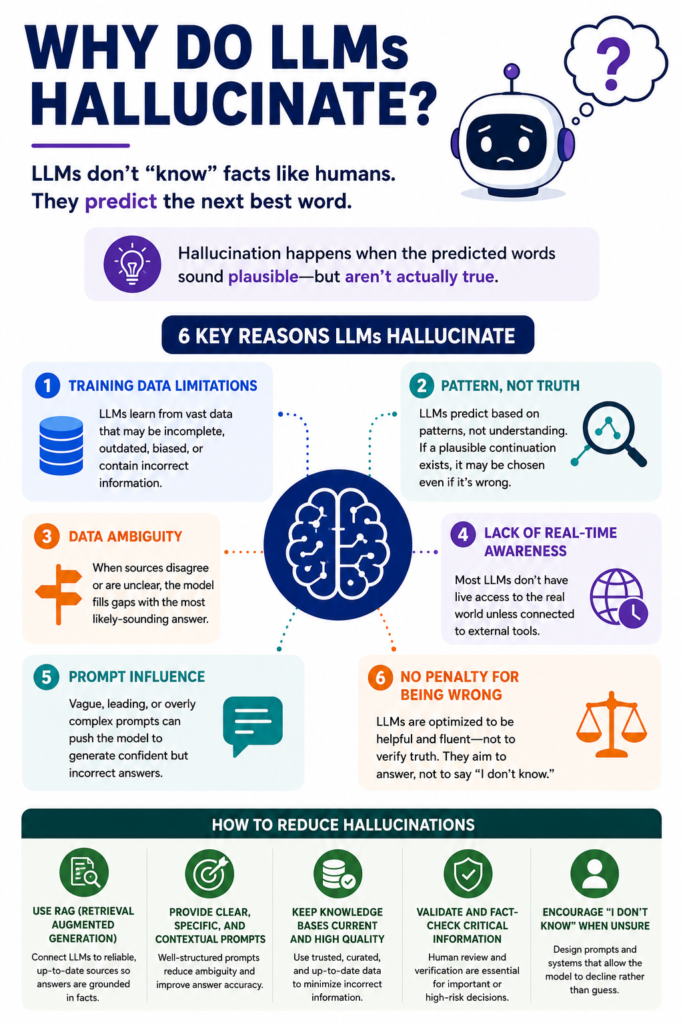
The key reason is that Large Language Models are not databases or search engines. They do not “know” facts the way humans do. Instead, they generate responses by predicting the most likely sequence of words based on patterns learned from vast amounts of training data. Their goal is to produce fluent and relevant text, not necessarily to verify whether every statement is true.
The Root Causes of Hallucinations
Several factors contribute to hallucinations. Training data may be incomplete, outdated, biased, or even contain errors. When information is missing or conflicting, the model attempts to fill the gaps using statistical patterns. This often results in answers that sound convincing but lack factual grounding.
Another reason is that most LLMs are optimized for helpfulness and coherence. During training, they learn to continue conversations smoothly rather than respond with “I don’t know.” As a result, they may generate an answer even when confidence should be low.
Prompt design also plays a significant role. Ambiguous, leading, or overly broad questions can push the model toward assumptions, increasing the likelihood of incorrect responses.
Why This Matters for Organizations
For businesses adopting AI, hallucinations are more than a technical issue—they are a governance challenge. Incorrect information can impact decision-making, customer trust, compliance, and operational efficiency.
This is why AI-generated content should be treated as a powerful assistant rather than an authoritative source. Human review, validation processes, and access to trusted enterprise data remain essential components of responsible AI adoption.
Reducing Hallucinations in Enterprise AI
Organizations can significantly reduce hallucinations by connecting LLMs to reliable and current knowledge sources through techniques such as Retrieval-Augmented Generation (RAG). Clear prompting, high-quality data governance, and continuous monitoring also improve response accuracy.
The future of AI is not about eliminating hallucinations completely; it is about building systems that recognize uncertainty, access trusted information, and provide transparent answers. The organizations that succeed will be those that combine the power of AI with strong data quality and human oversight.
Closing Thought
The biggest misconception about AI is that it thinks. In reality, it predicts. Understanding this distinction is the first step toward using Generative AI responsibly and effectively.
#ArtificialIntelligence #GenerativeAI #LLM #AILeadership #DigitalTransformation #EnterpriseAI #DataGovernance #ResponsibleAI #FutureOfWork #Innovation